
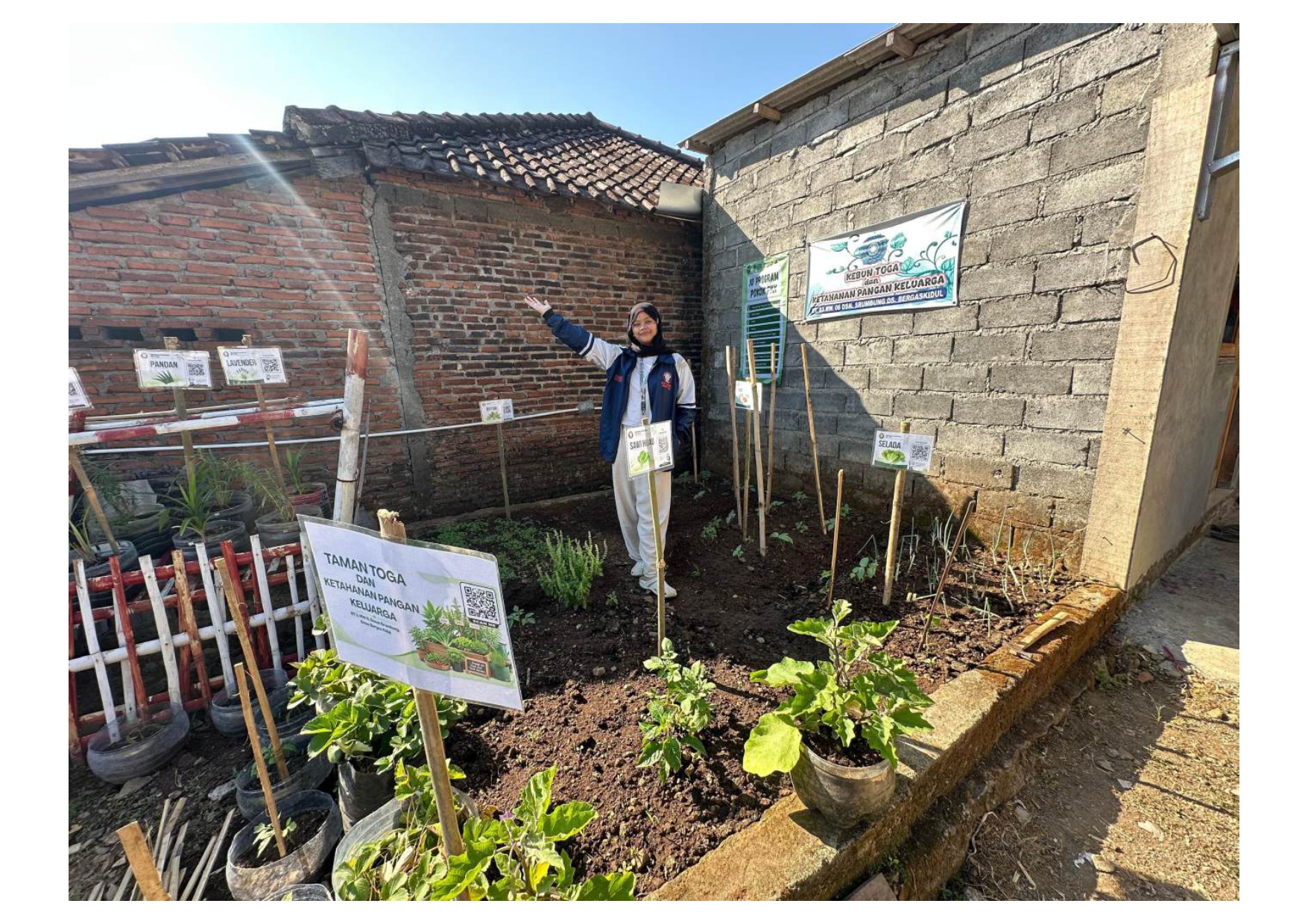
BERGAS KIDUL, SEMARANG REGENCY — A green and well-organized yard is not merely a matter of aesthetics — it also reflects a community’s awareness of how to make productive use of its surrounding environment. That spirit was what motivated Diva Dwi Putri Octaviani, a student of the Shipbuilding Construction Engineering Technology (TRKP) program at Diponegoro University, to carry out an individual work program focused on the design and arrangement of Family Medicinal Plants (TOGA) along with the installation of plant identity labels in Srumbung Hamlet, Bergas Kidul Village, as part of the Thematic Community Service (KKN-T) 29 Team 3 UNDIP.
The program was implemented as part of an effort to optimize yard greening through the cultivation of Family Medicinal Plants, while also serving as a component of the KKN-T 29 Multidisciplinary Task 2. The TOGA garden that had previously existed in Srumbung Hamlet was further developed through a reorganization of plant placement using polybags, along with the installation of identity labels on each plant. These steps were taken to ensure that the plants would be better organized, easier to maintain, and readily identifiable by the surrounding community.
In its implementation, polybags were chosen for their greater placement flexibility, allowing the position of each plant to be adjusted according to the available conditions and size of the area. Meanwhile, the installation of plant identity labels serves as a practical guide for residents to recognize the types of plants found in the TOGA area, along with the benefits each plant offers.
Diva’s background as a Shipbuilding Construction Engineering Technology student also shaped the approach she took in carrying out this program. Her skills in designing and organizing a space — taking into account spatial conditions, neatness, ease of access, and long-term sustainability of use, all of which she had studied in the context of ship design and maritime construction — she applied directly to the arrangement of the TOGA area. As a result, the work carried out was not merely oriented toward physical appearance, but also gave careful consideration to the long-term functional value of the area for the community.
The program did not stop at physical arrangement alone. With an organized layout system and informative identity labels now in place, it is hoped that the residents of Srumbung Hamlet will find it easier to recognize, care for, and sustain the presence of TOGA plants in their environment. The continued use of the TOGA area by the community is the primary goal this work program seeks to achieve.
Through this initiative, Diva demonstrated that the engineering knowledge she has acquired throughout her studies can be applied in meaningful and practical ways to address real community needs — transcending the boundaries that are often assumed to separate different fields of expertise. A simple contribution, yet one that carries deep significance for the greening and self-reliance of the people of Srumbung Hamlet.